HAIR LOSS (KHALITYA) TREATMENT
Jun 18, 2026
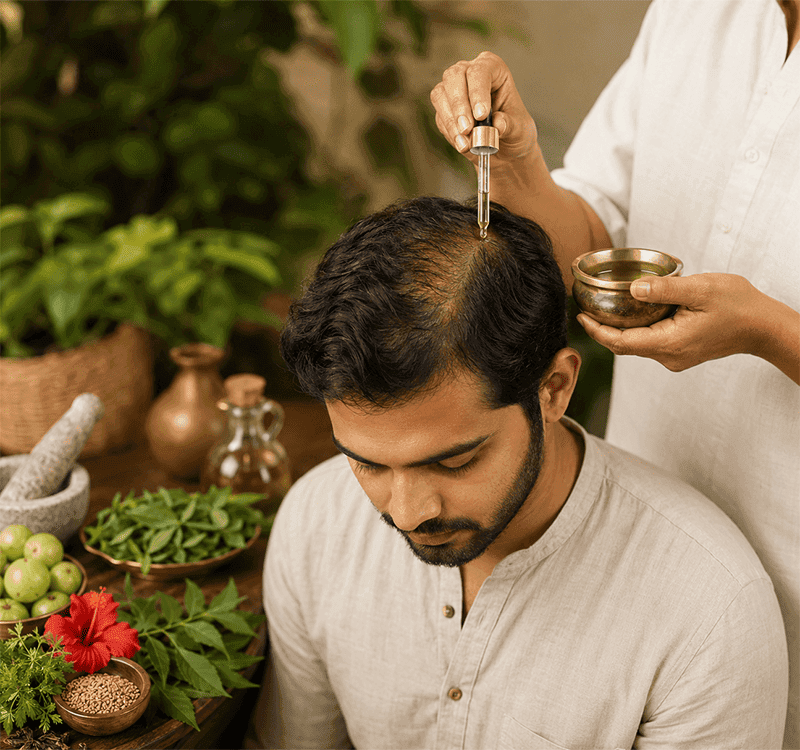
Hair problem is one of the most common problems occurring in today’s time, whether it is Receding hairline, Premature Greying, Hair thinning, Bald patches or diseases like Seborrheic Dermatitis, Alopecia Areata, Androgenetic Alopecia, Hirsutism, Folliculitis etc. In Ayurveda hair loss is known as “khalitya”. According to Ayurveda healthy hair reflects good digestive, balanced doshas, proper nourishment and strong body tissues.
Table of Contents:
- Stages of Hair
- Classification of pattern hair loss
- Treatments for hair loss
- Hair Transplant
- Diet and lifestyle importance in hair loss
STAGES OF HAIR
Hair grows in a continuous cycle consisting of four main stages: Anagen (the growth phase), Catagen (the transition phase), Telogen (the resting phase), and Exogen (the shedding phase).
Anagen Phase (Growth Phase): The first stage of the hair life cycle is known as the anagen phase. During this phase, hair actively grows from the hair follicle, which is located beneath the skin’s surface. This growth phase can last anywhere from two to seven years, and the length of anagen hair varies among individuals due to genetic factors. Factors such as genetic hormones and overall health significantly influence the duration of the anagen phase.
Catagen Phase (Transition Phase): After the anagen phase, hair enters the catagen phase, this transitional phase is relatively short, lasting only a few weeks. During catagen, the hair follicle shrinks and detaches from the hair strand. Hair growth ceases, and the hair becomes known as “club hair.” Approximately 3% of our scalp hairs are in the catagen phase at any given time. Factors such as genetic hormones and overall health significantly influence the duration of the anagen phase.
Telogen Phase (Resting Phase): The telogen phase is the resting period of the hair cycle, lasting 2-4 months. Hair growth ceases, but the hair remains in the follicle. Approximately 10–15% of scalp hairs are in telogen at any time. This phase allows the follicle to recover and prepare for the next growth cycle. External factors like stress, illness, or hormonal changes can increase the number of hairs entering telogen, sometimes leading to temporary shedding.
Exogen Phase (Shedding Phase): When the old hair is naturally shed from the follicle, making room for new hair to grow. Shedding is a normal part of the cycle, with individuals losing 50–100 hairs per day. This phase overlaps with the anagen phase of new hair growth, ensuring that not all hairs are lost simultaneously and maintaining overall hair density.
CLASSIFICATION OF PATTERN HAIR LOSS
MALE PATTERN HAIR LOSS
THERE ARE 7 STAGES:
TYPE 1: Minimal to no hair loss
TYPE 2: Receding hairline, often forming an “M” shape.
TYPE 3: Further receding hairline with thinning at the crown.
TYPE 4: Progressive hair loss, with the “M” shape becoming more pronounced.
TYPE 5: Wider balding areas and “M” shape is prominent.
TYPE 6: Balding areas merge, leaving a band of hair around the sides.
TYPE 7: Most severe stage, with only a narrow band of hair remaining.
FEMALE PATTERN HAIR LOSS
THERE ARE 3 STAGES (Ludwig scale):
TYPE 1: Mild thinning at the crown.
TYPE 2: More noticeable thinning and widening of the part.
TYPE 3: Extensive hair loss, often leaving a see- through scalp.
TREATMENTS FOR HAIR LOSS
There are number of various treatments available nowadays for hair loss (Ayurveda perspective).
SHIROABHYANGA
Shiro Abhyanga also known as “head massage” or “scalp care” in English, is a fundamental aspect of ayurvedic beauty and wellness practices. It is particularly beneficial for maintaining healthy hair and addressing various health related concerns.Proper application: The application of oil is followed by a gentle massage of the scalp and hair, focusing on acupressure points. This massage not only relaxes the mind but also stimulates hair follicles and aids in the absorption of the nutrients from the oil.
SHIRODHARA
procedure is a meticulous process that begins with a consultation to determine an individual’s dosha constitution to determine an individual lies down on a specially designed table while a continuous stream of warm herbal oil is poured gently onto their forehead. The oil flows over the scalp, and the therapist may use a gentle massage technique to enhance the oil’s penetration into the scalp and hair follicles.LEECH THERAPY
is not new, it has been used in ayurveda, since ages for various reasons.The leech’s saliva contains compounds like ‘hirudin’ and ‘histamine’ that have anticoagulant properties and have been used historically to treat various ailments with that.
Leech therapy increases blood circulation. Therefore, when leeches are applied to thinning or bald areas of the scalp, the increase in blood circulation helps to deliver and to concentrate the nutrients that assist in making the hair follicles strong. The therapy can assist in the promotion of hair growth. As with all treatments, the results will vary from individual to individual.
PLATELET RICH PLASMA THERAPY (PRP)
Plasma (PRP) therapy is one of the most popular non-surgical options for hair fall treatment in Delhi. In this procedure, growth-factor-rich plasma is extracted from the patient’s blood and injected into the scalpBENEFITS
Stimulates dormant hair follicles
Improves hair thickness
Reduces hair fall
Minimal downtime
Safe and natural procedure
PRP works best for people experiencing early-stage hair thinning and male or female pattern baldness.
GROWTH FACTOR CONCENTRATE (GFC)
It is an advanced version of PRP that delivers highly concentrated growth factors directly to the scalp. growth-factor-rich plasma is extracted from the patient’s blood and injected into the scalp.BENEFITS
Faster recovery
Improved hair density
Less discomfort
Effective for thinning hair
GFC is becoming increasingly popular as an advanced hair restoration treatment.
MESOTHERAPY
Mesotherapy involves injecting vitamins, minerals, and nutrients into the scalp to nourish hair follicles and improve scalp circulation.It is commonly used for:
Weak hair roots
Hair thinning solution
Dry scalp issues
Nutritional hair loss
SCALP MICRO PIGMENTATION
Scalp micropigmentation is a cosmetic treatment for thinning hair or hair loss. It’s sometimes also called a hair tattoo. A provider uses thin, small needles to deposit tiny dots of pigment (color) on the scalp. These dots give the appearance of thicker hair. Scalp micropigmentation pigments are cosmetic-grade, permanent inks.
Synthetic hair implants — also referred to as bio-fiber hair transplants — work differently than natural hair transplants.
To be a candidate for a natural hair transplant, you need enough healthy hair on your scalp that can be transplanted to the bald area that needs hair and the ability to grow hair on the thinning area of your scalp. A bio-fiber hair transplant, on the other hand, could be good for those who don’t qualify for a natural hair transplant due to insufficient hair or the inability to grow hair on the thinning section of the scalp.
Hair Transplant
Hair transplant surgery is recommended for individuals with significant baldness or permanent hair loss. Healthy hair follicles are transferred from donor areas to bald regions.
WHO CAN BENEFIT?
Men with advanced baldness
Receding hairline cases
Patchy hair loss
Individuals seeking permanent hair restoration
Hair transplant procedures provide natural-looking and long-lasting
HAIR WIGS/PATCH
Hair wigs provide full scalp coverage, while hair patches target specific bald or thinning areas, offering a natural, customizable, and cost-effective solution for hair loss.
Key Differences Between Wigs and Hair Patches
Coverage: Wigs cover the entire scalp, making them suitable for complete hair loss or dramatic style changes. Hair patches, also called hairpieces or toupees, cover only specific bald spots or thinning areas, blending seamlessly with existing hair for a natural look.
Material and Appearance: Both wigs and hair patches can be made from human hair or synthetic fibers. Human hair options offer the most natural appearance and styling flexibility, while synthetic options are more affordable and easier to maintain.
Comfort and Fit: Hair patches are generally lighter and more breathable than wigs, making them comfortable for long-term wear. Wigs may feel heavier and require proper sizing to stay in place.
Maintenance: Wigs require regular washing, conditioning, and styling, especially human hair wigs. Hair patches need less maintenance, with adhesives or clips replaced periodically, and can last several months with proper care.
DIET AND LIFESTYLE IMPORTANCE IN HAIR LOSS
NUTRITIONAL FACTORS
Essential Nutrients: Hair is primarily made of protein called “keratin”, which requires adequate protein for healthy hair growth deficiencies in essential nutrients such as zinc, iron, magnesium and some vitamins like vitamin B and vitamins D can lead to hair loss or hair thinning.
BALANCED DIET: A balanced diet rich in lean proteins, vegetables, fruits and healthy fats supports hair health. Foods like eggs, fish, nuts and leafy green provide the necessary nutrients for hair growth.
Diet high in processed food, sugar, red meat, excess caffeine can negatively impact hair growth.
DHT AND HAIR LOSS: Dihydrotestosterone (DHT) is a hormone that can contribute to hair loss. Certain foods, such as pumpkin seeds, green tea, and fatty fish, may help lower DHT levels and support healthier hair growth.
LIFESTYLE HABITS
SLEEP QUALITY: Adequate sleep is crucial for overall health, including hair health. Poor sleep can disrupt hormone balance and impede hair growth. Aim for 7-9 hours of quality sleep each night to support hair regeneration.
STRESS MANAGEMENT: Chronic stress can disrupt the hair growth cycle, leading to increased shedding. Stress management techniques such as mindfulness, yoga, and regular exercise can help mitigate this effect.
PHYSICAL ACTIVITY: Regular exercise improves blood circulation, delivering essential nutrients to hair follicles and promoting a healthy scalp. Incorporating activities like brisk walking or cycling can enhance hair health.
SCREEN TIME: In today’s lifestyle limiting yourself from excess screen time is very important, it can be a reason for stress, poor sleep quality, nutritional deficiencies, and a sedentary lifestyle.Prolonged exposure to blue light from screen can disrupt sleep cycle and lead to sleep disturbance, which in turn can affect hair health..